Across America, you’ll find attempted revitalizations of dormant downtowns long abandoned for the suburban mall or big box store. Cities are turning to the mixed-use concept to bring back Main Streets, constructing apartments over restaurants and communal workspaces over retail in hopes people return. Some are on the verge of success, some are not. The storefronts turn over. Visitors come once. Residents don’t stay.
What Main Street redevelopers are really trying to recreate isn’t a building type, however, it’s a culture. But culture isn’t constructed, it’s created organically — slowly and imperfectly over generations by the people who never left.
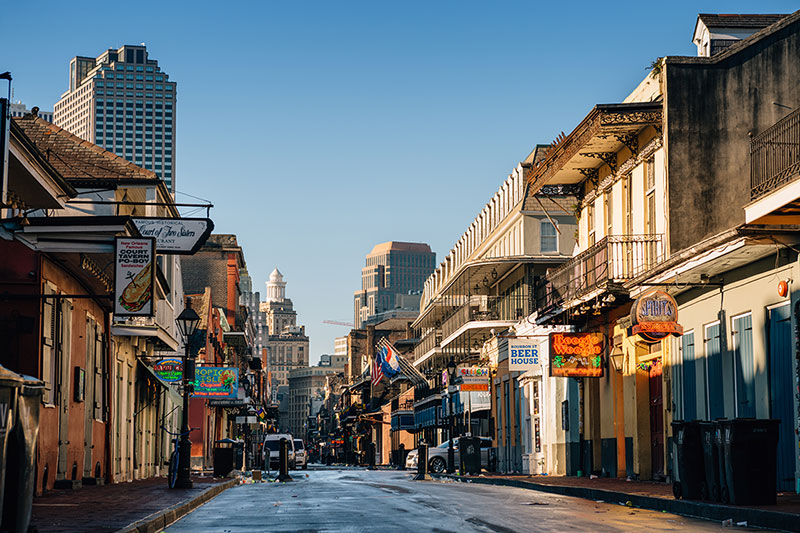
For more than 300 years, the French Quarter has been that place — people living above businesses, churches beside hotels, building community one block at a time. It evolved around people living, working, investing, celebrating and belonging in the same place.
That’s not just a New Orleans story, that’s the story every American city is trying to write right now, and mostly struggling to. The French Quarter endures because generations of people chose to stay in the same place and work it out.
A Balancing Act
But history doesn’t manage itself. Behind every great neighborhood is the daily, unglamorous work of keeping varying interests moving in the same direction — just like a second-line band. I’ve watched that unrealized alignment play out in real time in my work leading the French Quarter Management District — a resident concerned about noise while a business owner worries about foot traffic, both convinced the other is the obstacle.
What’s wonderfully clear to me is what they can’t yet see — they’re protecting the same neighborhood in different ways.
Nobody experiences a second-line band in quite the same way, but everyone shares in it together — just like the French Quarter.
Perhaps that’s why the second-line band feels like such a fitting reflection of the French Quarter itself — residents, businesses, hospitality, culture and visitors sharing the same streets, the same sidewalks and the same future.
Worth working for
According to our recent economic impact study, 14 million people visit the French Quarter every year. And yet, it still feels like a neighborhood. Same character. Same tradition. Same rhythm.
Conversations about lighting, sidewalks, parking, traffic, public safety and quality of life take on an entirely different meaning in a neighborhood that welcomes that many visitors each year. These infrastructure issues are neighborhood investments — pure and simple. A functioning streetlight to French Quarter residents and workers means a well-lit walk home after dinner or to your car after work. For a visitor, it’s the confidence to wander one more block, discover another gallery, stop in for one more live music performance.
One investment. Value shared by everyone.
In addition to ensuring nearly 900 historic streetlights shine bright, FQMD funds more than 10,500 extra patrol hours on our streets all year long. We’ve enhanced street corners so emergency vehicles can better access the Quarter and installed pedestrian crossing beacons on busy Rampart Street.
This month, we’ve introduced a revitalized French Quarter Task Force App that allows anyone in the French Quarter to report a safety incident and receive a response in five minutes or less.
Keeping the Rhythm
New participants join every day, but they don’t create the rhythm.
The rhythm is sustained by the residents and businesses who have chosen to build their lives here — tending their storefronts, restoring historic buildings, investing in the same few square blocks every single day.
Leadership in a mixed-use neighborhood is recognizing that residents and businesses share the same success. It’s revealing the common ground that was always there.
Someone has to keep the route clear, the path safe and the conditions in place for everyone to keep moving together. The French Quarter Management District — in step with every resident and business — makes the investments that allow the French Quarter to remain a better place to live, work and visit for everyone who calls it home, builds a business here, or discovers it for the first time.
The rhythm of the French Quarter has never belonged to any one group or event. It has always belonged to the generations who built it — and it belongs to everyone willing to invest in its future.
Most conversations about the French Quarter begin with the 14 million. I hope this one ends instead with what’s most impressive: that it’s a neighborhood owned by the people who never leave it, and who take on the work of making sure it endures.
Our responsibility isn’t to change its rhythm, it’s to protect it.