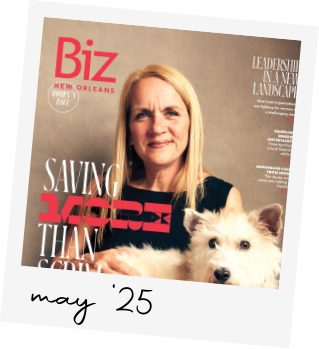
Along with sister companies VPG Construction and VPG Management, VPG Holdings is a vertically integrated multifamily real estate investment and investment platform headquartered in New Orleans. The platform owns and operates more than 1,300 apartment units across the Gulf South — with a pipeline approaching 2,000 — and is focused on preserving and recapitalizing affordable and mixed-income housing. Recent milestones include acquiring 200 Carondelet, a 189-unit downtown high-rise, and advancing Rivana at River District, a 220-unit ground-up development. On the construction side, the team is delivering the Xavier Ochsner College of Medicine.
What are you most excited about in the coming year?
I think we all can feel a new energy and momentum in the state and city around development and attracting new opportunities. Rivana at River District — 220 units of new housing in a district that will define New Orleans — is a great example of one of those opportunities. Taking place over the next decade, this project provides a chance to prove that new development here can be both ambitious and attainable. Another project, 200 Carondelet, is an example of exactly the work I built this company to do. We recently acquired this 189-unit downtown high-rise and are reinvesting in it, unit by unit.
On the construction side, VPG Construction is completing the Xavier Ochsner College of Medicine, the latest HBCU to establish a medical school, which will train physicians for our communities that have long gone underserved.
What is the biggest challenge facing your industry today, and is anything being done about it?
Operating costs are outrunning what residents can pay. Insurance premiums, property taxes and utilities have climbed far faster than rents in market, and that gap is where housing deals die. A property can be full and well-run and still not pencil.
I think there is effort, however, to turn this around. Louisiana’s insurance reforms and fortification incentives are beginning to bring capacity back to the market. Locally, tools like PILOTs (payment in lieu of taxes) and ad valorem exemptions (reductions or eliminations of property taxes based on the assessed value of a property) can make workforce housing viable, and the city is actively examining how to apply them. Public capital through the Louisiana OCD (offices of community development) and the state have kept deals alive that private markets alone would have passed on.
But the tools are still applied case by case. What the industry needs is a predictable framework developers can underwrite to years in advance.