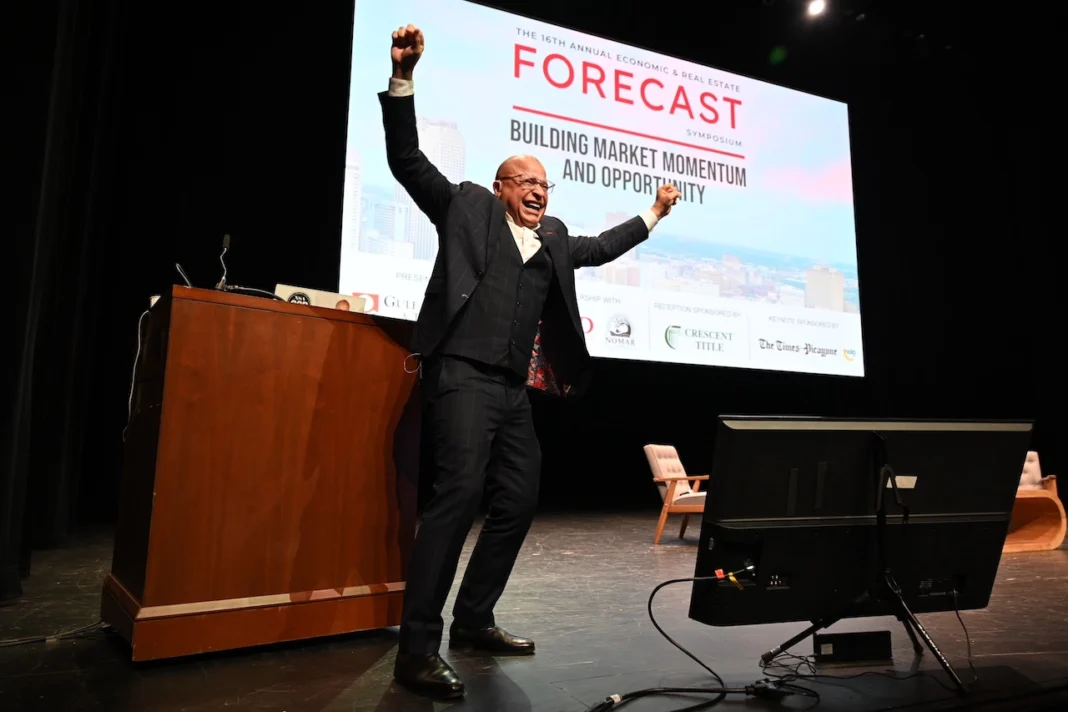
NEW ORLEANS — A slowly improving housing market, new opportunities for commercial real estate development and the potential impact of billions of dollars in statewide investment were among the major topics examined at the 16th Annual Economic and Real Estate Forecast Symposium on Oct. 8. The event is hosted each year by the New Orleans Metropolitan Association of REALTORS (NOMAR).
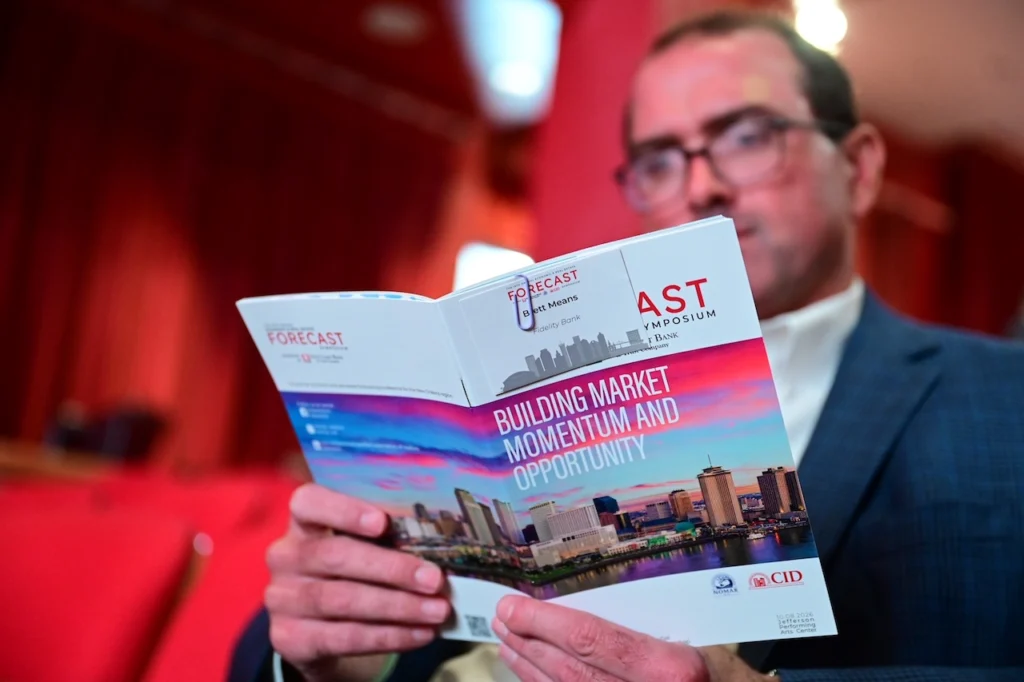
Held at the Jefferson Performing Arts Center in Metairie, the event brought together economists, developers, real estate professionals and business leaders to examine Greater New Orleans’ economic outlook for 2027. Discussions highlighted growing opportunities in healthcare, maritime and industrial development, along with persistent challenges involving housing affordability, financing costs, insurance and workforce availability.
“One of the most valuable things about the Forecast Symposium is bringing different perspectives together to look at where our market is headed,” said Cameron Lombardo, chairman of NOMAR’s 2026 Forecast Symposium. “There are opportunities ahead for Greater New Orleans, but we also have challenges to address. Understanding both is important as businesses, investors and real estate professionals make decisions for the coming year.”

Housing Market Shows Signs of Improvement
The Greater New Orleans housing market is beginning to pick up, although sales have yet to return to pre-pandemic levels. According to figures presented by Gary Wagner, an economist at the University of Louisiana at Lafayette, home sales are averaging approximately 1,038 per month, compared with an average of 1,199 per month from 2013 to 2019.
Home sales have strengthened over the past six months, particularly on the Northshore. In St. Tammany Parish, year-to-date home sales were up 11.1% through August compared with the same period in 2025, outpacing the New Orleans metro area’s 6.1% increase.
“We’re still in a cool market, but I think we’re in a thawing market,” Wagner said during the symposium’s Momentum in the Economy session.
There are other encouraging signs. Pending sales have also strengthened, and housing inventory is tightening. But buyers aren’t necessarily finding what they need. Much of the available inventory is concentrated at higher price points, particularly in the Central Business District, French Quarter, Tremé and Marigny, according to Lombardo.
Even when buyers find a suitable property, financing remains another obstacle.
“I expect steady, gradual improvement, and how fast it comes depends mostly on rates, since Wagner identified financing costs driven by national conditions as the biggest brake,” Lombardo said.
Insurance costs remain another consideration for developers and investors.
“From where I sit, insurance is still one of the biggest factors in underwriting for both homes and commercial property,” Lombardo said. “It affects what buyers can pay and whether renovations or new construction make sense.”
And it’s not just financing costs changing who can buy a home. Jessica Lautz, deputy chief economist and vice president of research at the National Association of REALTORS, discussed national trends showing that the median age of first-time homebuyers has reached a record 40, while first-time buyers account for just 21% of purchases. Inflation, student loan debt and childcare costs are making it increasingly difficult for younger buyers to enter the market.
At the other end of the age spectrum, older homeowners are also playing a significant role in the housing market. Lautz noted that some baby boomers are moving closer to family, while others who consider downsizing remain in their homes. Nationally, baby boomers accounted for 42% of homebuyers and 55% of sellers, according to NAR’s 2026 research, making them the largest generational group in both categories.
Commercial Real Estate Opportunities Expand
Industrial real estate has emerged as a promising sector. Drew Remson of First Horizon Bank pointed to the Port of New Orleans’ planned Louisiana International Terminal in St. Bernard Parish, which could increase the need for warehouses, distribution facilities and housing. The terminal is projected to support more than 4,300 direct and indirect jobs in St. Bernard Parish at full operation, according to an April 2026 economic impact analysis released by Greater New Orleans Inc.
And the potential benefits aren’t limited to St. Bernard Parish. Lombardo said investments in technology, logistics, life sciences and infrastructure could create opportunities across Jefferson Parish, the Northshore, the River Parishes, the West Bank and New Orleans.

The office and retail markets are showing different trends. Lombardo said Greater New Orleans has avoided some of the widespread office vacancies seen nationally, partly because the region has relatively few major office towers.
Retailers, meanwhile, are becoming more selective about store locations. “Retail is strong, but there’s a flight to quality,” Lombardo said. “National retailers that would open several stores in other markets are focused here on smaller footprints, strategically placed across the metro.”
Those opportunities are part of a much larger conversation about how Greater New Orleans can benefit from Louisiana’s surge in economic development investment.
“Louisiana has real momentum. As our panelists pointed out, the state has announced more than $250 billion in economic development projects over the past year. The big question in the room was how Greater New Orleans turns that into jobs, housing demand and deals here at home,” Lombardo said.
Josh Fleig, chief innovation officer at Louisiana Economic Development, put the statewide investment figure at approximately $260 billion, much of it tied to AI and the data center infrastructure needed to support it.
“Honestly, most of the more than $250 billion announced is outside New Orleans, so we have to be intentional about capturing it,” Lombardo said. “Port expansion, the medical district projects and supplier and housing demand across the metro are how that investment reaches us.”
Andy Kopplin of the Greater New Orleans Foundation pointed to several major healthcare initiatives, including Tulane University’s pursuit of a $500 million redevelopment of the former Charity Hospital building, the newly established Xavier Ochsner College of Medicine in downtown New Orleans and efforts by LSU Health and LCMC Health to secure National Cancer Institute designation for their cancer center.

But attracting investment is only part of the challenge. The region also needs workers who can fill the jobs being created.
“It’s up to us to seize this moment,” Kopplin said. “We have the chance to power the future with jobs that have been announced throughout the state, but only if we get the people who are here in Louisiana attached to those jobs with good wages and growth potential.”
NOMAR
The New Orleans Metropolitan Association of REALTORS (NOMAR) represents residential and commercial real estate professionals across Greater New Orleans, providing market research, industry education and advocacy on issues affecting the region’s real estate industry.
Biz New Orleans Magazine Editor’s Note: The October 2026 issue of Biz New Orleans Magazine focuses on real estate, with more stories examining the trends, developments and opportunities shaping the Greater New Orleans market. Click here to explore the issue.