
NEW ORLEANS — Louisiana Works is preparing to shift control of workforce development funding, contracts and oversight from 15 local boards to a centralized statewide system beginning in early 2027. The restructuring is aimed at improving coordination of job training and employment services at a critical time as billions of dollars in industrial and technology investments create growing demand for skilled workers across the state.
The overhaul follows a January executive order from Gov. Jeff Landry and legislation approved during the 2026 legislative session to consolidate oversight of the state’s workforce system.
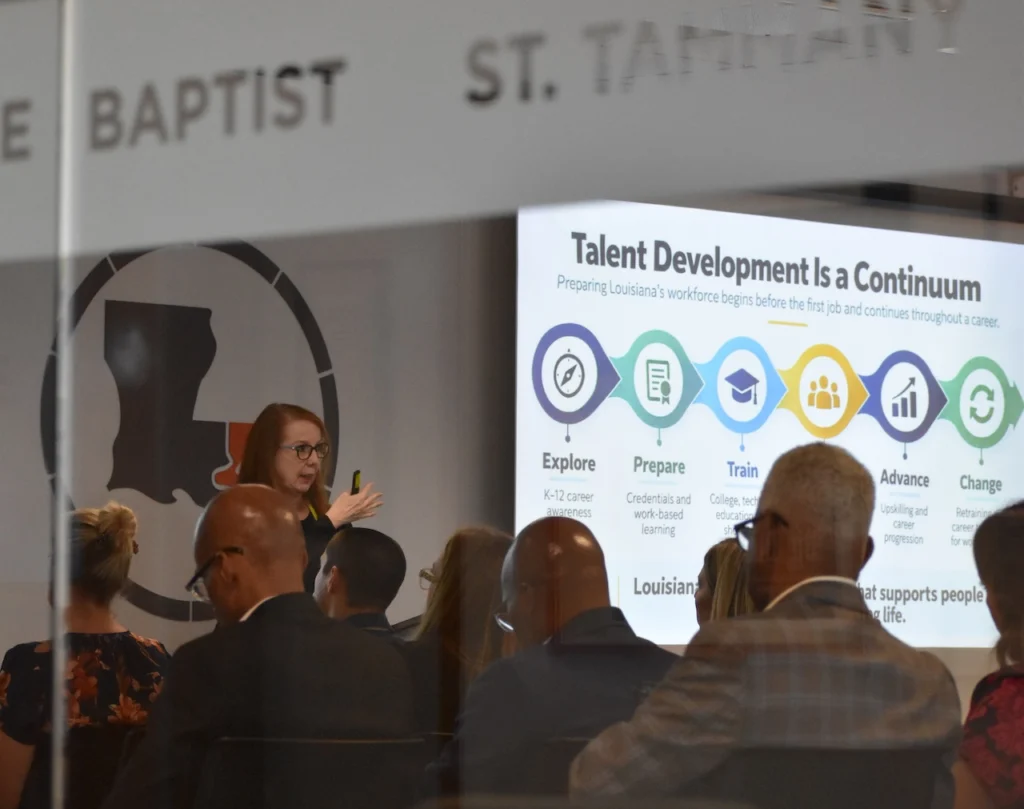
To help guide the transition, Louisiana Works launched Louisiana At Work: Building a Modern Workforce Statewide, a series of regional meetings designed to gather input from employers, education and workforce leaders and community organizations. The tour began Aug. 26 in Shreveport and Monroe, with additional stops scheduled through October in the New Orleans, Capital, Central Louisiana, Northshore, Acadiana, Southwest Louisiana and Bayou regions.
“We’re hearing that employers want a system that’s easier to navigate, more responsive, and better connected to their hiring and training needs,” said Louisiana Works Secretary Susana Schowen. “Our partners are also emphasizing the importance of preserving what works locally, particularly the relationships and regional expertise that help connect people to opportunities.”
Schowen acknowledged concerns about local decision-making, staffing, funding and the continuity of services.
“Those concerns are understandable. We’re changing a structure that’s been in place for decades, and people deserve to know what that means for their communities,” she said.
How the Transition Will Work
The restructuring follows the U.S. Department of Labor’s approval in August of a waiver allowing the Workforce Investment Council (WIC) to assume governance functions traditionally performed by Louisiana’s 15 local workforce development boards. Under the new structure, WIC will establish statewide policies, set priorities and oversee performance, while Louisiana Works will handle administrative and financial responsibilities, including funding management, procurement, contracting and compliance.
Five specialized teams are assessing the 15 local workforce areas, including site visits to examine operations, contracts, staffing and readiness. The teams are focused on financial, operational, policy, technology and implementation issues.
“Our goal is to begin the first transitions in early 2027, with the broader process taking approximately 18 months,” Schowen said. “Each area will transition according to its readiness, with individualized plans to address operational needs and maintain services. We’re deliberately taking a phased approach. There’s no value in moving quickly if it creates disruptions for the people and businesses we’re trying to serve.”
What Happens to Local Decision-Making?
One of the most significant changes involves the authority currently exercised by local workforce development boards, which oversee programs and funding decisions within their respective regions.
In New Orleans, for example, the New Orleans Workforce Development Board has overseen the selection of private contractors to operate JOB1, the city’s American Job Center, and deliver federally funded employment and training services. In 2025, the city evaluated six proposals for those services, with Equus Workforce Solutions receiving the highest score and submitting a proposed budget of $3.8 million.
Similar arrangements exist elsewhere in Louisiana. In Shreveport, the local workforce development board selected Eckerd Connects to serve as its One-Stop Operator under a contract of up to $91,000 annually, while Eckerd has also provided workforce services in Acadiana.
Under the centralized structure, those boards will no longer retain their existing governance responsibilities. Louisiana Works is developing a Regional Workforce Advisory Council model intended to give employers, economic development organizations, education and training providers, local governments and other stakeholders a formal role in shaping regional workforce priorities.
“Regional leaders will no longer exercise the same formal governance authority they have under the current local board structure. That is a real change,” Schowen said. “But it doesn’t mean decisions about regional workforce needs should be made without regional leadership.”
The proposed councils would provide recommendations on funding priorities, service design, employer engagement and performance expectations. “We don’t need 15 separate governance structures to recognize that the workforce needs of Greater New Orleans are different from those of North Louisiana or Acadiana,” she said.
Louisiana Works plans to use regional labor market data, employer demand and training capacity to guide funding decisions, but the detailed decision-making framework remains unfinished. “Our leadership team is still finalizing the detailed decision-making framework, including what responsibilities can be delegated and how regional recommendations will inform state-level decisions,” Schowen said.

Staffing and American Job Centers
The restructuring will also change oversight of Louisiana’s 62 American Job Centers, which provide employment assistance, career counseling, training referrals and other workforce services. The centers will remain part of the statewide system, with consistent standards for service quality, eligibility, case management and performance.
Staffing decisions remain unresolved.
“Regarding staffing, we haven’t made decisions about reductions, and I don’t want to get ahead of the assessments underway,” Schowen said. “We do expect administrative structures and responsibilities to change, and we’ll evaluate those functions carefully as part of each area’s transition plan. Our objective is not to reduce frontline service capacity. Quite the opposite. We want more resources available for career counseling, training, employer services, and helping people overcome barriers to employment.”
Funding Shift Could Direct Millions More to Training
Approximately 27% of Louisiana’s Workforce Innovation and Opportunity Act (WIOA) Title I funding currently goes toward direct participant services, including training, career services, apprenticeships and assistance that helps people obtain and maintain employment, according to Schowen.
The state’s plan calls for increasing that share to 35% in the first program year, 40% in the second, 45% in the third and at least 60% in the fourth. Louisiana’s Program Year 2026 WIOA Title I allocations total approximately $41.7 million. At that funding level, increasing the direct-service share from 27% to 60% would shift approximately $13.8 million more annually toward participant services.
Schowen said the figure is illustrative rather than a finalized savings projection, with actual amounts dependent on federal funding and the state’s financial assessments. “But the principle is straightforward – we want to spend less on duplicative administration and more on helping people gain skills, overcome barriers, and move into good jobs,” she said.
Measuring Workforce Results and Accountability
Louisiana Works plans to introduce monthly statewide performance dashboards with regional results beginning in Program Year 2027. The reports are expected to track training participation, credential attainment, employment, earnings growth, employer demand, administrative efficiency and the share of funding devoted to direct services.
“We’re going to measure success by what the system delivers, not simply how many people participate in programs,” Schowen said. “That means tracking how many people enter training, earn credentials, secure employment, increase their earnings, and advance in their careers. Someone seeking assistance in Monroe should have access to the same basic quality of services as someone in New Orleans or Lake Charles, even if the specific programs available differ based on regional needs.”

Preparing Workers for Louisiana’s Investment Boom
The restructuring comes as Louisiana faces substantial workforce demands from major industrial and technology developments, including Meta’s planned data center in Richland Parish and Hyundai Steel’s proposed steel mill in Ascension Parish.
Schowen said Louisiana has announced more than $260 billion in capital investment since January 2024, while approximately 95,000 job openings remain across the state. She also cited a labor force participation rate of 58.4%.
“The scale of economic opportunity ahead of Louisiana is one of the biggest reasons we’re making these changes now,” Schowen said. “Those numbers tell an important story: we have tremendous opportunity, but we need to connect more people to it.”
The modernization effort includes several related initiatives. Talent Works, a new office within Louisiana Works, is intended to coordinate workforce solutions for employers. The Statewide Talent Strategy is being developed to align education, training and workforce investments with anticipated industry needs.
Schowen also pointed to efforts under the One Door to Work Act to better connect workforce programs with related services, along with initiatives involving Workforce Pell, the M.J. Foster Promise Program, apprenticeships and industry-based credentials.
Beyond the demand created by new industrial investments, existing businesses also need workers. The workforce system also faces additional demand from changes to public benefit programs. A January executive order from Gov. Jeff Landry estimated that more than 200,000 Louisianians would have to meet new eligibility requirements under changes involving Medicaid and other federal benefits.
“Do we have all the capacity we need today? Not yet,” Schowen said. “We have outstanding institutions, strong industry partnerships, and a solid foundation to build on. But we need greater coordination, more accessible training, and the ability to respond much faster. Economic development announcements don’t automatically become career opportunities for Louisiana residents. We have to make those connections intentionally. That’s what this modernization effort is designed to accomplish.”